

There’s no question that VMware environments have become mission-critical in modern enterprises. They host the apps and services that keep businesses running: from finance to healthcare to customer experience. But this centrality also makes them a prime target. And attackers have noticed.
According to Sophos, 66% of ransomware attacks on VMware result in successful data encryption, often bypassing outdated protections and causing significant operational impact. Even worse? The average ransom demand tied to compromised VMware ESXi servers reached $5 million in 2024 (Source: Hackers News 2024 Report). These are not small nuisances, they’re existential threats.
For many IT and security teams, this begs the question: Is our current VMware backup strategy enough?
Spoiler alert: For most, the answer is no. And that’s where a shift from backup to cyber resilience comes in.
Why Traditional VMware Backup Isn’t Enough Anymore
VMware environments are complex, spanning data centers, end-user devices, and public cloud infrastructure. But many organizations still rely on legacy backup tools that weren’t built for today’s hybrid, high-speed, and high-risk reality.
These traditional tools often depend on hardware appliances, manual processes, and fragmented security postures. That means slow recovery, siloed management, and backup data that’s just as vulnerable as the systems it’s supposed to protect.
So what’s the solution? Moving to a modern model that views data protection as a continuum of cyber maturity, not just as a static insurance policy.
The Cyber Resilience Maturity Model: Your Roadmap Forward
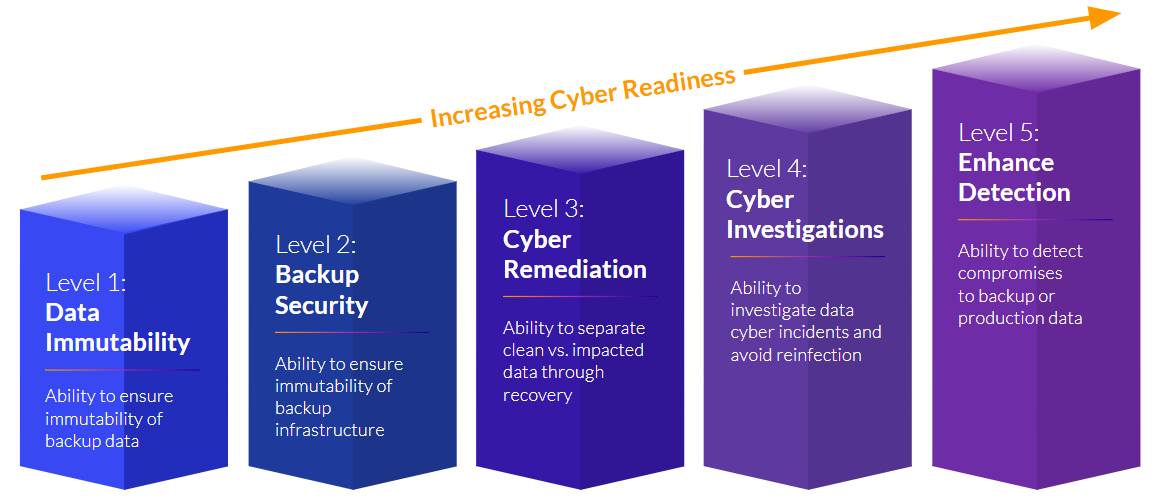
At Druva, we think about cyber resilience not as a product feature, but as a journey. Our Cyber Resilience Maturity Model helps customers assess their current state and, more importantly, identify where they need to go.
Here’s a quick breakdown of the five levels:
- Data Immutability: Can your backup data be tampered with or encrypted by ransomware?
- Backup Security: Is your backup infrastructure protected by zero trust and immutable to threat actors or insiders?
- Cyber Remediation: Can you isolate clean data and recover confidently after an attack?
- Cyber Investigations: Do you have tools to understand what happened and why?
- Enhanced Detection: Are threats proactively spotted before they do damage?
Let’s unpack what this looks like in practice, and how Druva supports each stage.
Level 1: Locking Down Your Backups
If your backups can be deleted or encrypted during an attack, then they’re not really backups. Druva starts at the foundation: air-gapped, immutable backups with data lock policies and encryption in-flight and at-rest. These protections ensure your backup data is unchangeable, even from insider threats.
You can think of this as building your digital fireproof safe: no matter what burns down, your critical data is still intact.
Level 2: Securing the Infrastructure
The next step is making sure attackers can’t access your backup platform in the first place. Druva separates control and data planes, implements Zero Trust access controls, and provides multi-factor authentication and role-based access controls (RBAC). Our protected audit logs ensure you can investigate suspicious activities, and self-service rollback actions capabilities provide a quick undelete function in the event of accidental or malicious deletion of recovery points.
This keeps your recovery path clean, even if your primary systems are compromised.
Level 3: Responding and Recovering Fast
When something does go wrong — and let’s be honest, it will — the key is getting back online quickly without spreading the infection. Druva offers sandbox recovery, snapshot quarantine, and rollback automation to restore operations cleanly.
No more worrying whether your “backup of a backup” might be infected. You get verified recovery points and orchestrated workflows that take the guesswork (and panic) out of ransomware response.
Level 4: Understanding What Happened
It’s not enough to just recover. Your stakeholders, from the CISO to the compliance team, will want answers. Druva gives your IT and security teams forensic audit trails, snapshot comparisons, and GenAI-assisted investigation tools that help you pinpoint the source, scope, and timing of an incident.
You’re not just restoring systems, you’re restoring confidence.
Level 5: Staying Ahead of the Threat
The final stage in the maturity journey is all about proactive detection. With 24x7x365 Managed Data Detection & Response (MDDR), Druva’s threat experts monitor your environment for signs of compromise before you even know it’s there.
It’s like having a cybersecurity analyst on call, watching over your VMware data, all included with the platform.
Here’s a graphic picture of these levels.