For years, enterprise backup was built around a familiar model: deploy backup software, manage servers and proxies, store data on disk, replicate to another target, and eventually send copies to the cloud. Many organizations still operate this way through D2D2C — disk-to-disk-to-cloud — because it feels familiar, controlled, and proven.
But the cyber resilience question has changed.
Today, backup infrastructure is not just an insurance policy. It is a high-value target. If attackers can compromise backup servers, steal administrative credentials, disable repositories, or poison recovery points, the organization's last line of defense can become part of the attack path.
That is why the Druva vs. Veeam conversation should not be reduced to "who can back up the workload." Veeam is a capable platform with strong recovery depth, broad workload support, and mature virtualization capabilities. The better question is: who owns the operating model behind cyber resilience, the customer or the platform?
For business-critical data, that distinction matters.
The Legacy Burden: Backup Infrastructure Has Become a Risk Surface
Traditional data protection architectures give customers significant control. But control also means responsibility.
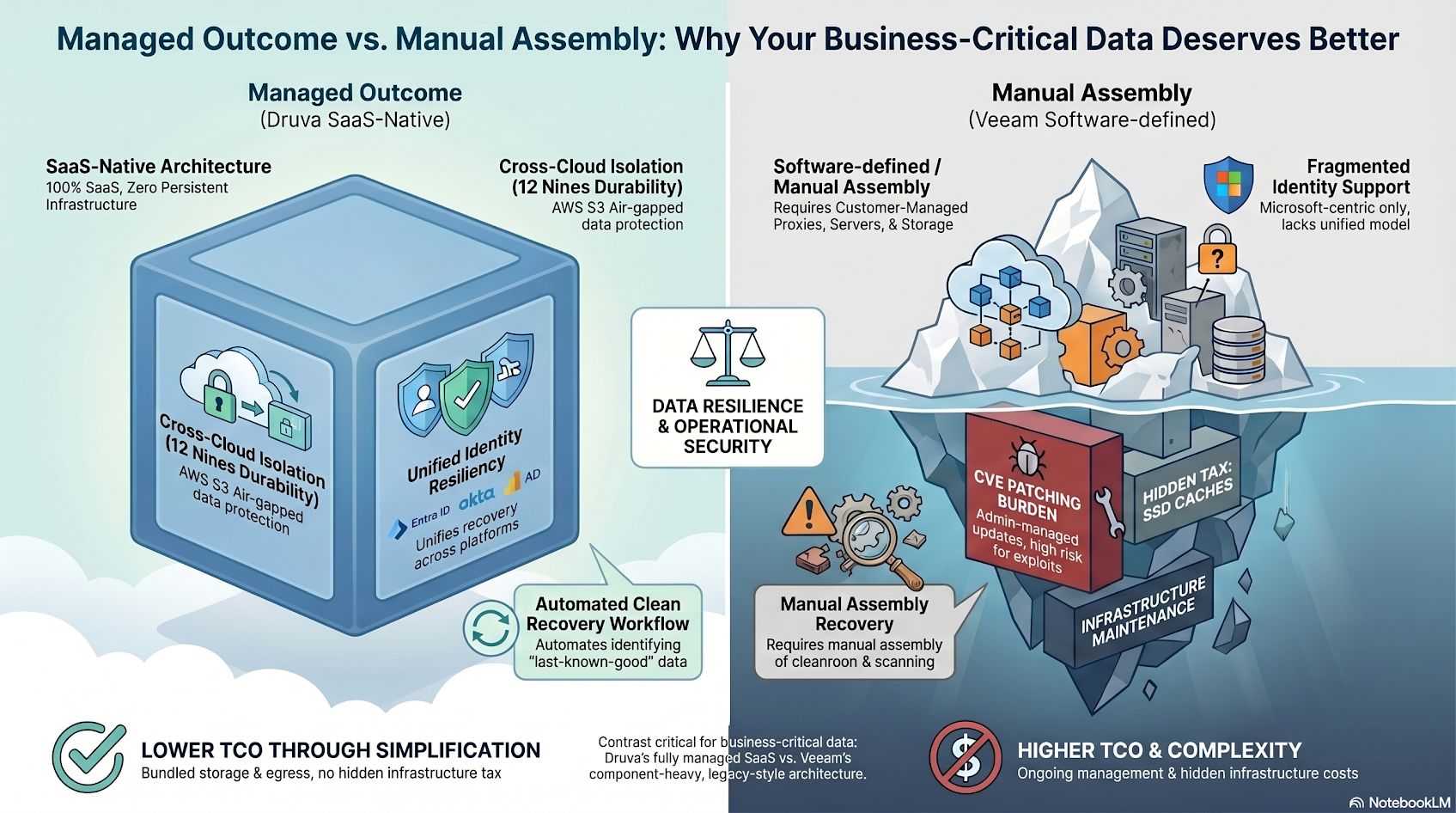
In a Veeam-style software-defined model, organizations often need to operate and secure backup servers, repositories, proxies, storage targets, operating systems, databases, and related orchestration components. That flexibility can be valuable, especially for organizations with deep virtualization, physical recovery, or complex on-premises disaster recovery requirements. But it also means the customer must manage more of the security lifecycle.
When a new CVE appears, the customer must ask: Who is responsible for patching the backup server? Who validates the operating system, database, proxy, and repository hardening? Who confirms the patch does not break compatibility? Who applies updates across distributed environments? Who verifies that backup data remains recoverable after the change?
Druva's SaaS model changes this operating model by removing customer-managed backup infrastructure from the runbook. Instead of asking customers to build, patch, and maintain backup servers, Druva delivers data protection as a fully managed SaaS platform.
Key message: The risk is not that Veeam lacks security features. The risk is that many Veeam deployments still require customers to continuously secure and maintain the infrastructure that protects their most important data.
Business-Critical Data Needs Isolation from the Production Blast Radius
For Microsoft 365, cloud applications, and cloud-native workloads, business-critical data increasingly lives outside the traditional data center. That creates a new resilience challenge: where should backup data live, and how isolated is it from the production environment?
Same-cloud protection can be convenient. For example, a Microsoft 365 environment backed up into Azure-based storage may simplify procurement and data locality. But convenience is not the same as architectural separation. If production identity, cloud accounts, administrative access paths, and backup storage are all concentrated in the same cloud ecosystem, customers should ask whether their "air gap" is operationally strong enough during a security incident.
Druva's position is stronger when framed as cross-cloud isolation by design. Druva provides a SaaS architecture that separates backup data from the production environment and reduces shared operational dependencies between production systems, administrative identities, and recovery data.
Key message: Air-gapped backup is not just about immutability. It is about reducing shared dependencies between production systems, administrative identities, and recovery data.
The Real Recovery Question: Can You Restore the Latest Clean Data?
Traditional backup products are often strong at retention depth. They can provide many recovery points across days, weeks, months, or years. But after ransomware, the hard question is not simply which backup exists.
The hard question is: Which recovery point is clean?
Ransomware often has dwell time. Malware, suspicious scripts, encrypted files, or compromised identities may exist in the environment before the final encryption event. A backup that completed successfully may still contain compromised data. Restoring that backup may reintroduce the threat.
This is where the Druva vs. Veeam comparison should focus on recovery confidence. Veeam has credible cyber recovery capabilities, including malware detection, immutable backups, clean recovery validation, and recovery orchestration. The stronger Druva message is not that Veeam cannot recover data. It is that Druva operationalizes clean recovery through a SaaS-led workflow with fewer customer-managed components.
Druva's Curated Recovery approach helps organizations identify a clean recovery set by analyzing backup data, quarantining suspicious snapshots, and helping teams recover a known-good version of business-critical data.
Key message: The future of recovery is not "restore the last backup." It is "identify, validate, and recover the latest clean data with evidence."
Veeam's Strength Is Also Its Complexity
Veeam's breadth is real. It has strong virtualization capabilities, deep VMware and Hyper-V heritage, physical bare-metal recovery, orchestration options, Kubernetes through Kasten, and flexible infrastructure choices. That makes Veeam a powerful fit for organizations that want maximum control over recovery engineering.
But the same breadth can create complexity. Depending on the customer's environment, Veeam may involve different products and workflows across data center workloads, cloud-native workloads, Kubernetes, Microsoft 365, Entra ID, Salesforce, monitoring, orchestration, and recovery validation.
That is the central contrast: Veeam gives customers more control. Druva removes the work.
Key message: Druva is SaaS-first as the operating model, not SaaS as one module in a broader stack.
Identity Resilience: The Overlooked Recovery Dependency
Modern cyber resilience is not only about restoring files, VMs, or SaaS objects. It is also about restoring trust in identity.
If Active Directory, Entra ID, or Okta is compromised, restoring application data may not be enough. Customers need to recover users, groups, roles, policies, and identity configurations so they can safely re-establish access to business systems.
This is where Druva can tell a broader identity resilience story across Active Directory, Entra ID, and Okta. The point is simple: a clean recovery plan must include identity. Without trusted identity, restored data may still be inaccessible, unsafe, or exposed to the same attacker path.