Veeam: More moving parts = more customer burden
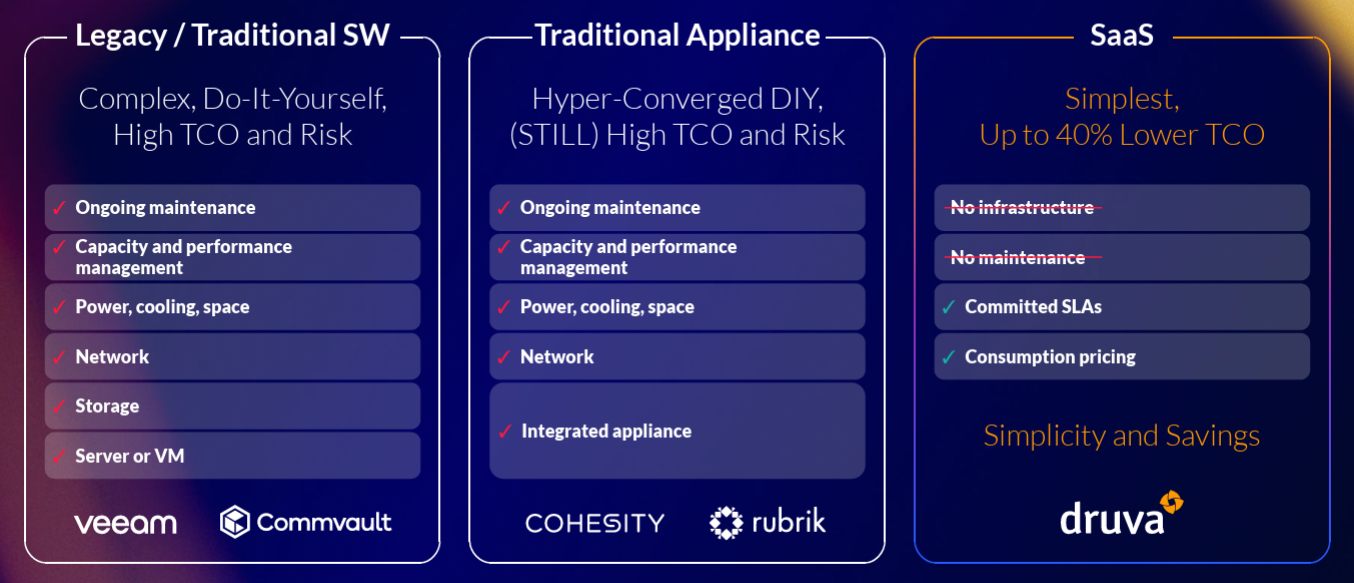
Veeam requires customers to source, secure, manage, and refresh multiple products, creating a significant customer burden. In contrast, Druva presents a fully managed model. In an active incident, this difference is critical: with Veeam, teams may be handling the crisis while also worrying about whether every backup component is hardened, patched, and configured correctly. Druva’s advantage is clear: fewer products and less customer-owned infrastructure create less friction and reduce operational risk when every minute matters. Get the full details on the Druva vs. Veeam page.
Commvault: Simpler than legacy but still layered
Commvault is a cloud-adapted software, while Druva is built on a fully managed, cloud-native SaaS model with managed compute and storage. In an incident, this difference matters. If the protection stack still depends on additional components, policy tuning, or operational oversight, recovery planning becomes more complicated. Druva's advantage is that a fully managed SaaS model cuts those dependencies, simplifying recovery. Get the full details on the Druva vs. Commvault page.
Rubrik: Strong capabilities, but YOU do the work
Rubrik is considered a DIY data platform, meaning customers still design, size, deploy, and operate infrastructure and software layers. Druva offers a fully managed SaaS approach. During a cyber event, Rubrik's approach increases operational drag. Druva's advantage is a single control plane and zero management overhead, which reduces the work required to protect and recover critical data. Get the full details on the Druva vs. Rubrik page.
Cohesity: Hybrid complexity remains
Cohesity requires customers to manage software on appliances or hardware. Druva is fully managed SaaS, with no infrastructure to deploy or operate. For security teams, this comes down to simplicity: if recovery still depends on infrastructure you own and operate, incident response becomes more involved. Druva's advantage is its approach, which is meant to reduce that footprint and simplify security operations. Get the full details on the Druva vs. Cohesity page.
Why the fully managed model matters more under pressure
- The backup and cyber resilience platform itself does not become another infrastructure project during the incident.
- The customer spends less time patching components, validating server-side dependencies, or coordinating upgrades across products.
- Recovery teams can focus on business-critical data and clean restore paths instead of protection-platform maintenance.
- A single control plane and predictable subscription model make decision-making easier when speed matters most.
The hardware-dependent challenge: when memory and capacity pressure shows up
Another important part of the story is hardware dependence. Appliance-based and infrastructure-heavy models do not just increase deployment complexity. They also create ongoing capacity planning pressure.
When organizations face memory shortages, infrastructure constraints, or refresh cycles in hardware-dependent environments, cyber resilience can become harder to scale smoothly. And the market is taking notice…
Hosted deployments now account for roughly three‑quarters of backup installations, rising from 52% in 2020 to 72% in 2025 as buyers prioritize ease, automation, reliability, breadth of coverage, and responsive support. In 2026, infrastructure volatility adds a new risk category: procurement-gated resilience. When backup depends on backup servers, scale-out nodes, or appliance expansions, resilience inherits lead times, quote windows, and repricing.
Druva rises to the occasion — deployable in minutes, fully managed for you, and continuously updated — so organizations protect, govern, and rapidly recover data. Read our white paper to explore how Druva is ideal for this new “cloud-native era.”
Druva wins when customers look closely at TCO
Druva also has a strong story for customers evaluating total cost of ownership. All-in-one subscription economics are a welcome relief from the layered licensing, add-ons, hardware costs, and customer-managed operations common with legacy solutions.
That matters because TCO is not only about product price. It is about the full cost of running the protection model over time: infrastructure, storage, compute, maintenance, upgrades, staffing effort, and the hidden cost of complexity during a security event.
For customers carrying heavy products or infrastructure-intensive architectures, Druva’s case becomes compelling. The more operational weight the customer is carrying today, the clearer the value of a cloud-native, fully managed model with predictable subscription costs.
Get the details on how Druva customers typically save around 40% TCO after switching from Veeam.
One stop shop, not another stack of products or bolt-on
This is where the larger Druva narrative comes together. Druva is a one-stop shop for data protection, cyber resilience, and identity resilience across enterprise, cloud, SaaS, and end-user environments. Druva also strengthens cyber resilience beyond backup alone with capabilities such as Druva MDDR with Safe Mode. This helps security and IT teams detect suspicious activity earlier, protect backup environments from unauthorized changes, and recover with greater confidence when identity-based attacks put both access and data at risk.
That one-stop-shop message is especially powerful for enterprises that want a simpler cyber protection and detection model for business-critical data. Instead of assembling multiple tools and carrying the operational burden internally, they can move to a fully managed architecture designed to reduce complexity from day one.
Bottom line
When customers compare Druva with Veeam, Commvault, Rubrik, and Cohesity, the strongest differentiator is not just feature depth. It is the operating model. Druva gives enterprises a simpler, fully managed, one-stop-shop approach that reduces hardware dependence, lowers TCO pressure, and improves readiness when security incidents put both identity and data at risk.
Conclusion
When a security incident happens, complexity becomes visible fast. The question is not just which vendor offers backup features. The real question is which architecture helps enterprises reduce the number of systems, steps, and decisions involved in protecting and recovering critical data.
Druva’s fully managed model is simpler to run, easier to scale, and better aligned to enterprises that want strong cyber protection without carrying the overhead of hardware-heavy or operationally heavy alternatives.
See for yourself! Switch to Druva and get up to 6 months of our industry-best data security FREE!
Explore the full comparisons: