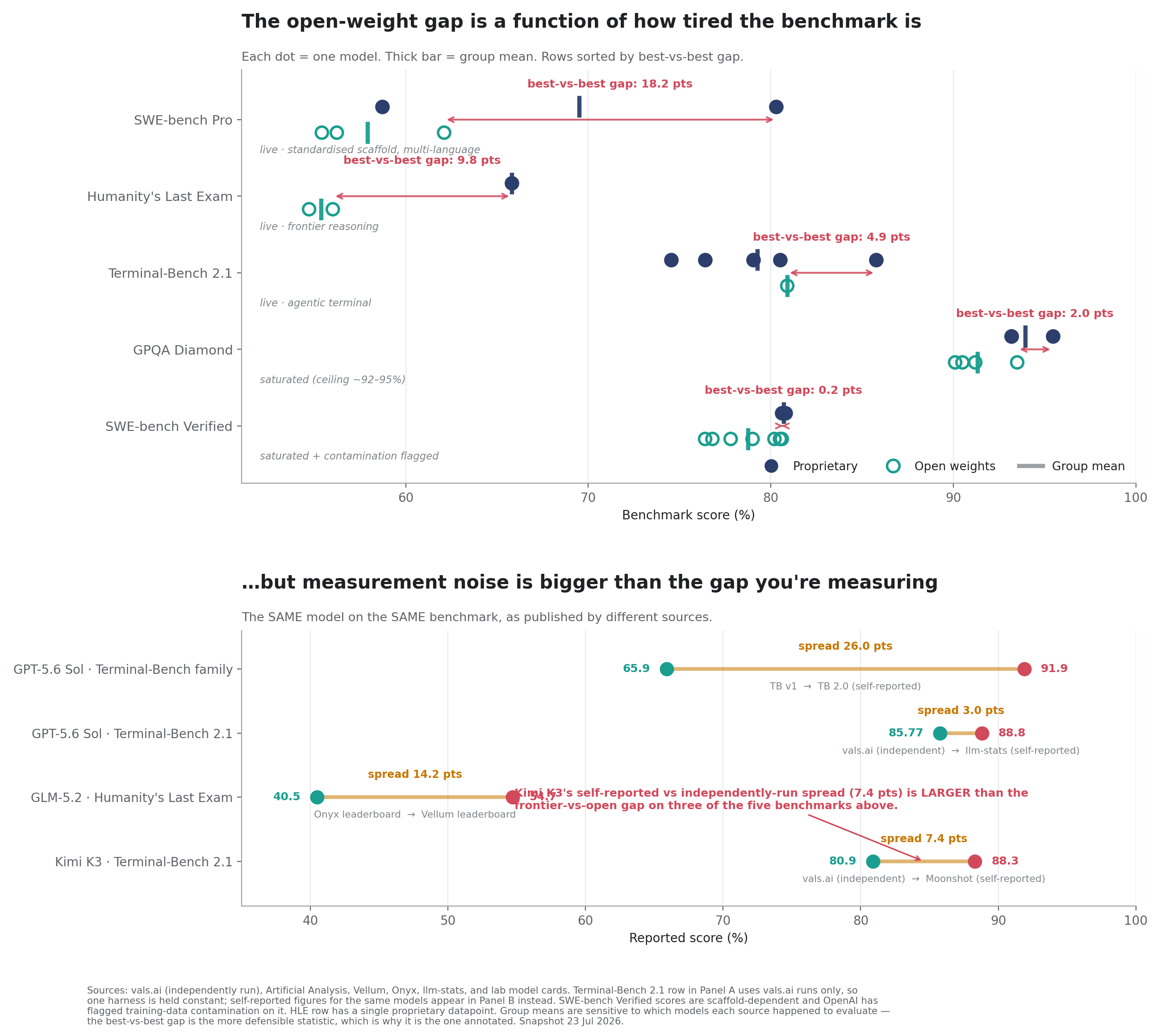
Chart 6. Top: the gap widens as benchmarks get fresher. Bottom: the same model scores differently depending on who published the number.
The ordering is monotonic and it is not a coincidence. On the two benchmarks that show up in every launch post the gap is essentially zero. On fresh ones with a pinned scaffold and multi-language tasks it is eighteen points. Benchmark selection is itself a signal, incidentally: at least one lab published SWE-bench Pro results while skipping Verified entirely.
Open models fall furthest behind on the newest and most realistic tests, which is exactly the kind of work you would give an agent.
Then the noise swamps what is left. Kimi K3 scores 80.9% on Terminal-Bench 2.1 when an independent party runs it and 88.3% when Moonshot reports it. GLM-5.2 shows up at 40.5% and 54.7% on Humanity's Last Exam depending on which leaderboard you read. That 7.4 point self-reporting spread is larger than the frontier-versus-open gap on three of the five benchmarks above. One popular leaderboard lists fifteen models on Terminal-Bench 2.1 with zero verified results and fifteen self-reported.
Moonshot's own launch table mixes four different agent harnesses across rows, and they note that harnesses which truncate the model's chain of thought cause significant degradation. Their numbers make the case better than I can.
A score is not really a property of the model. It is a property of the model, the scaffold it runs in, and the compute budget it was given. Publish one number and you have hidden the other two.
Cost per token is misunderstood, and switching is oversimplified
Test-time compute means a model can spend more effort on a hard question instead of being permanently larger. A small model that thinks for a while can match a big model that answers immediately, and you only pay for the thinking when you need it. That turns a set of decisions that used to be trivial into most of the engineering:
Which model gets this query?
How much reasoning budget should we grant it?
What context carries forward and what gets dropped. Whether to run one agent or five?
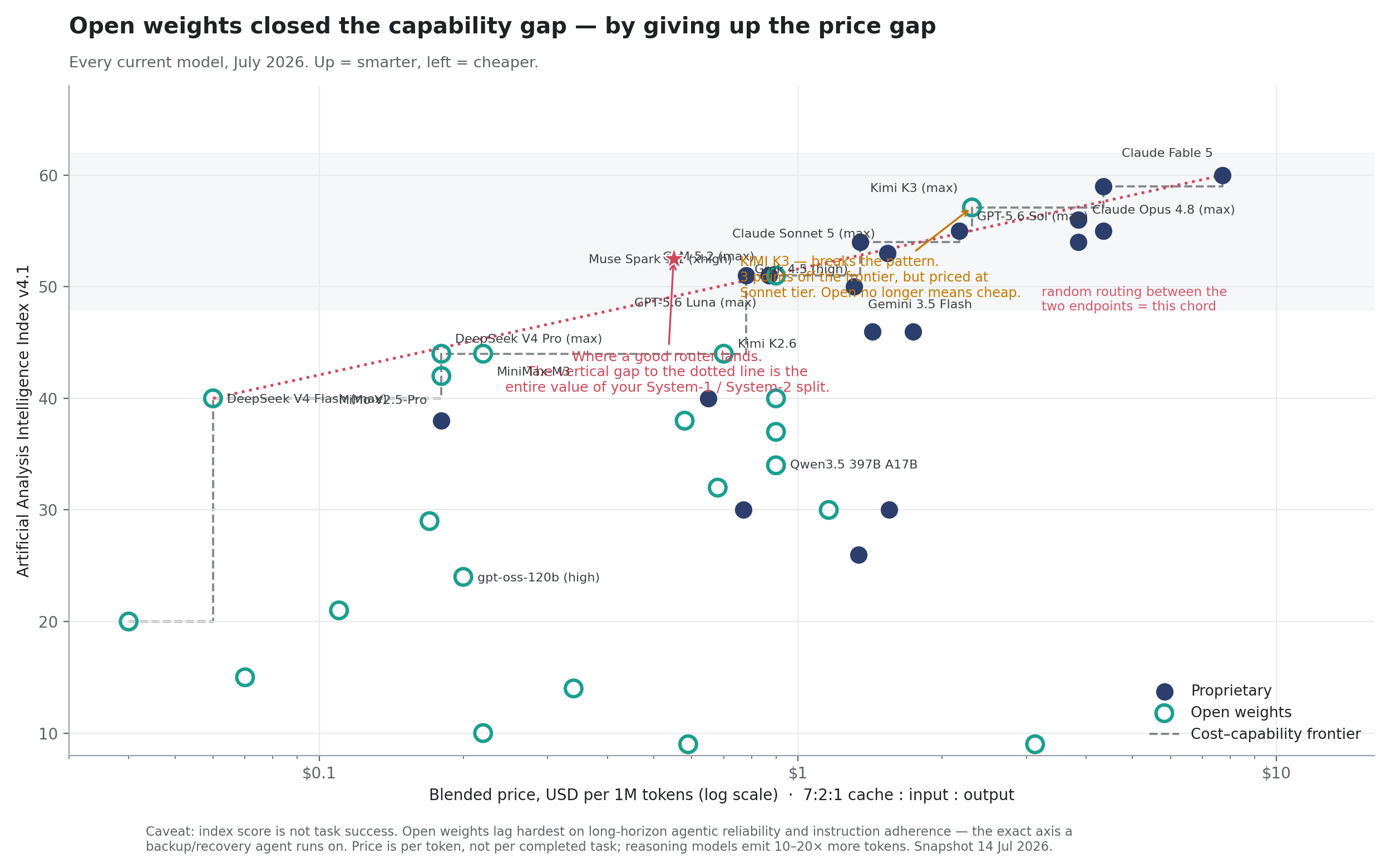
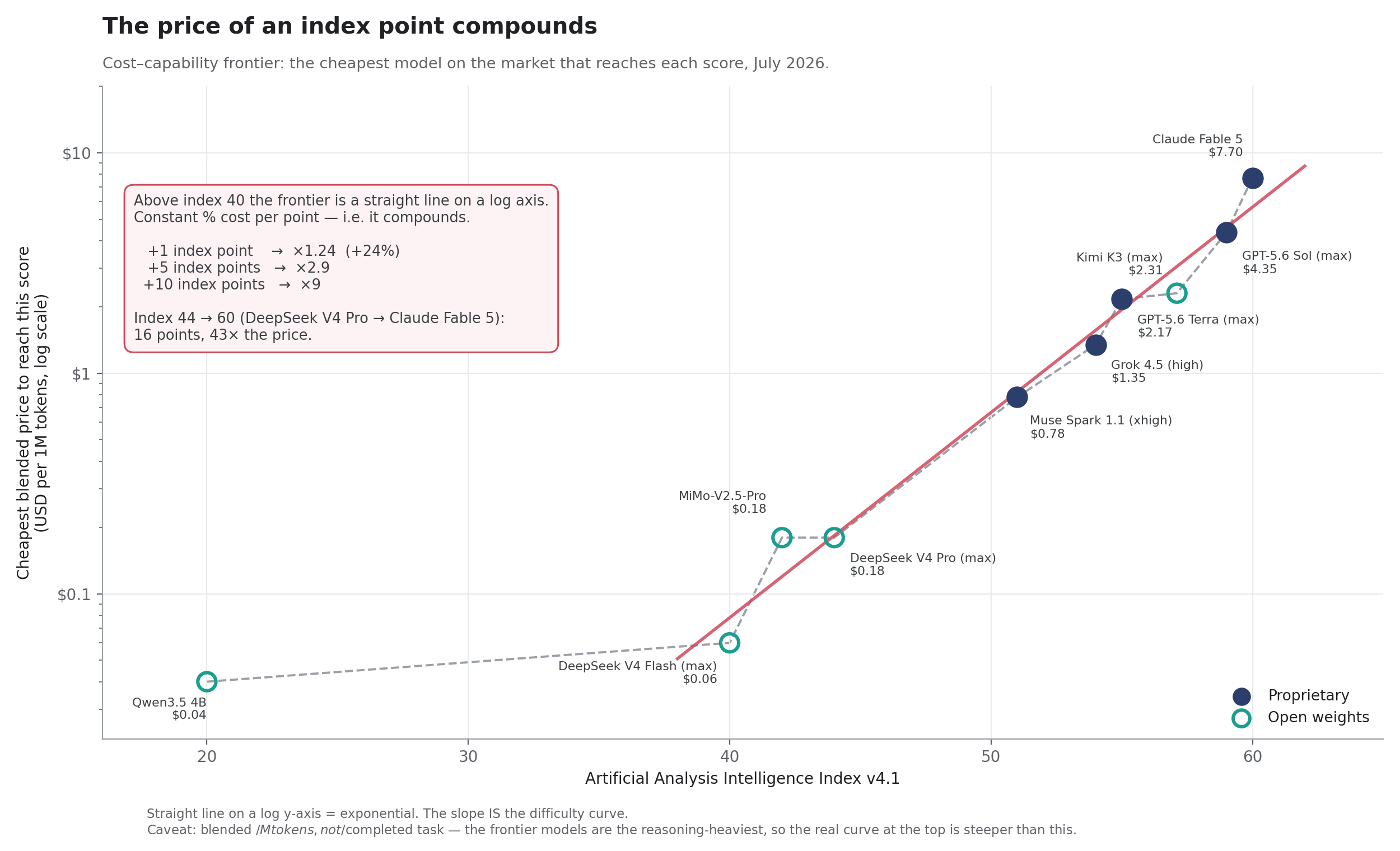
The economics push the same way. On the current cost-capability frontier each additional index point costs about 1.24 times the last one. Five points is roughly 2.9x, ten points roughly 8.5x. So the top nine points of capability cost around ten times what everything below them costs.
If you send every request to the best available model, most of that spend buys capability the request never needed.
The obvious fix is to route easy work to a cheaper model, and there is a trap in it that almost nobody prices in. Published prices assume roughly 70% prompt-cache hits, and caches are maintained per provider by construction. Route across vendors mid-session and the hit rate goes to zero.
Scenario
| Blended $ / 1M tokens
|
|---|
Kimi K3, cache working
| $2.31
|
Claude Opus 4.8, cache working
| $3.85
|
Kimi K3, cache broken by the switch
| $4.20
|
Reasoning traces do not port between vendors either. And Bedrock's prompt routing, which people assume solves this, only routes within a model family. Cross-vendor routing is yours to build.
You switch to save money and end up paying more than the model you were avoiding. Route between models at the start of a job, not in the middle of one.
What about security and safeguards?
This is the part of the open versus frontier comparison that never shows up on a benchmark chart, and it is really a question about who is responsible for what.
With a frontier API, the provider owns the safety layer. They tune the model, run red teams against it, patch behavior after release, and carry the reputational, and increasingly, the legal exposure. You inherit that work whether you value it or not, and it is part of what the price buys.
Open weights invert the arrangement. You get the weights, and the safety posture becomes yours. The uncomfortable finding is how thin the built-in protections are. A joint Financial Times and Alice investigation published in May 2026 tested this. A freely available tool stripped the safety protections from Llama 3.3 and Gemma 3 in under ten minutes, on a standard laptop. Once modified, the models answered prompts on biological weapons, malware, and child sexual abuse material that the originals were built to refuse. The tool had reportedly been used to produce over 3,500 modified variants with 13 million cumulative downloads. Separate work puts the compute cost of a fine-tuning run that strips alignment at under fifty dollars.
Guardrails applied during training can be identified and removed afterwards. For a locally deployed model, your governance controls, rather than the model's training, are the load-bearing safety mechanism.
The labs know this. OpenAI adversarially fine-tuned gpt-oss-120b before release, deliberately trying to strip its safety, and treated the result as a release condition. A deployer running their own fine-tunes downstream has no equivalent gate.
It is also why a small industry of guard models now exists, from Llama Guard and Prompt Guard to gpt-oss-safeguard. Their only job is to watch the other model. Research on multi-turn attacks adds a wrinkle: open-weight models tend to degrade over a long conversation rather than failing at the first prompt, and capability-focused releases hold up worse than safety-focused ones.
There is a regulatory edge too. The EU AI Act gives open-source general-purpose models a carve-out from some documentation obligations. But obligations land on the enterprise deployer once a significant modification is made, and a LoRA fine-tune can qualify. Enforcement dates arrive in August 2026. Most teams running fine-tunes have not read that clause.
Running several models from several providers shifts the responsibility again, this time sideways. Every additional vendor is another data processing agreement, another region, another certification scope, another content policy that can change under you, and another uptime dependency. Route through an aggregator to simplify that and you have handed security, resilience, and governance to a third party. Your incident response now depends on theirs.
With a frontier API, you rent the safety work. With open weights, you own it. With five providers, you have outsourced it to whoever sits in the middle. None of those is wrong, but only one of them is free.
So which model should you use?
Open weights are genuinely competitive for well-specified, short-horizon work where you control the scaffold and can measure the result yourself. Classification, extraction, summarization, structured generation, the long tail of internal tooling. On those, the capability gap is inside the measurement error and the price difference is material.
The frontier still earns its price on long-horizon agentic work, instruction adherence under pressure, and anything where a failure is expensive to detect after the fact. That is where the fresh benchmarks put the gap at eighteen points rather than zero, and where the safety layer you are renting has the most value.
There is also a procurement dimension the charts never show. Open weights means the weights, not the data, and licenses vary more than people expect. Kimi K3 was still pending a public license when I pulled this data. For anything shipping in a regulated product, that is a legal review, not a footnote.
This is a narrower claim than either camp usually makes, but it is the one the data supports.
Part 3. What could come next
This part is opinion built on the data above rather than a finding from it.
Pre-training's era is ending, which should make models cheaper
Sutskever's line at NeurIPS was that pre-training as we know it will end, because compute keeps growing while data does not. He called data the fossil fuel of AI. There is one internet, we have largely consumed it, and the returns from scaling that stage alone have flattened.
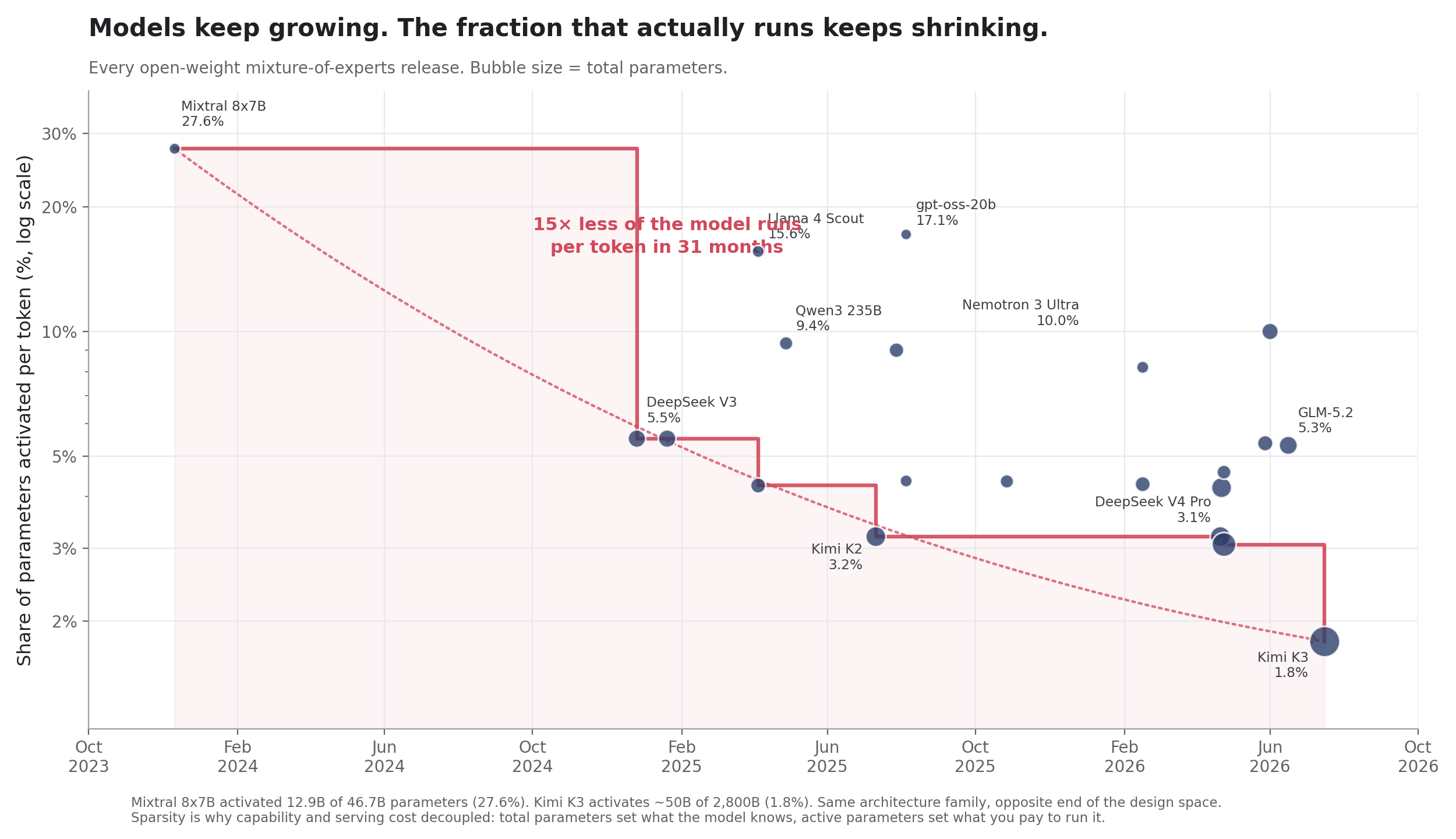
I do not read that as progress stalling. Everything in Part 1 is evidence the work moved elsewhere: to compression and mid-training, to reinforcement learning on verifiable rewards, to inference-time compute. What I do expect is the cost consequence described earlier, arriving slowly. If the differentiator stops being who ran the biggest pre-training job, that fixed cost stops needing to be amortized across every API call.
The counterpoint is that this has been predicted before and the timeline keeps slipping. Labs are still spending enormous sums on pre-training, and synthetic data may extend the runway further than the peak-data argument allows.
Baseline intelligence goes to nearly free. Judgment gets expensive.
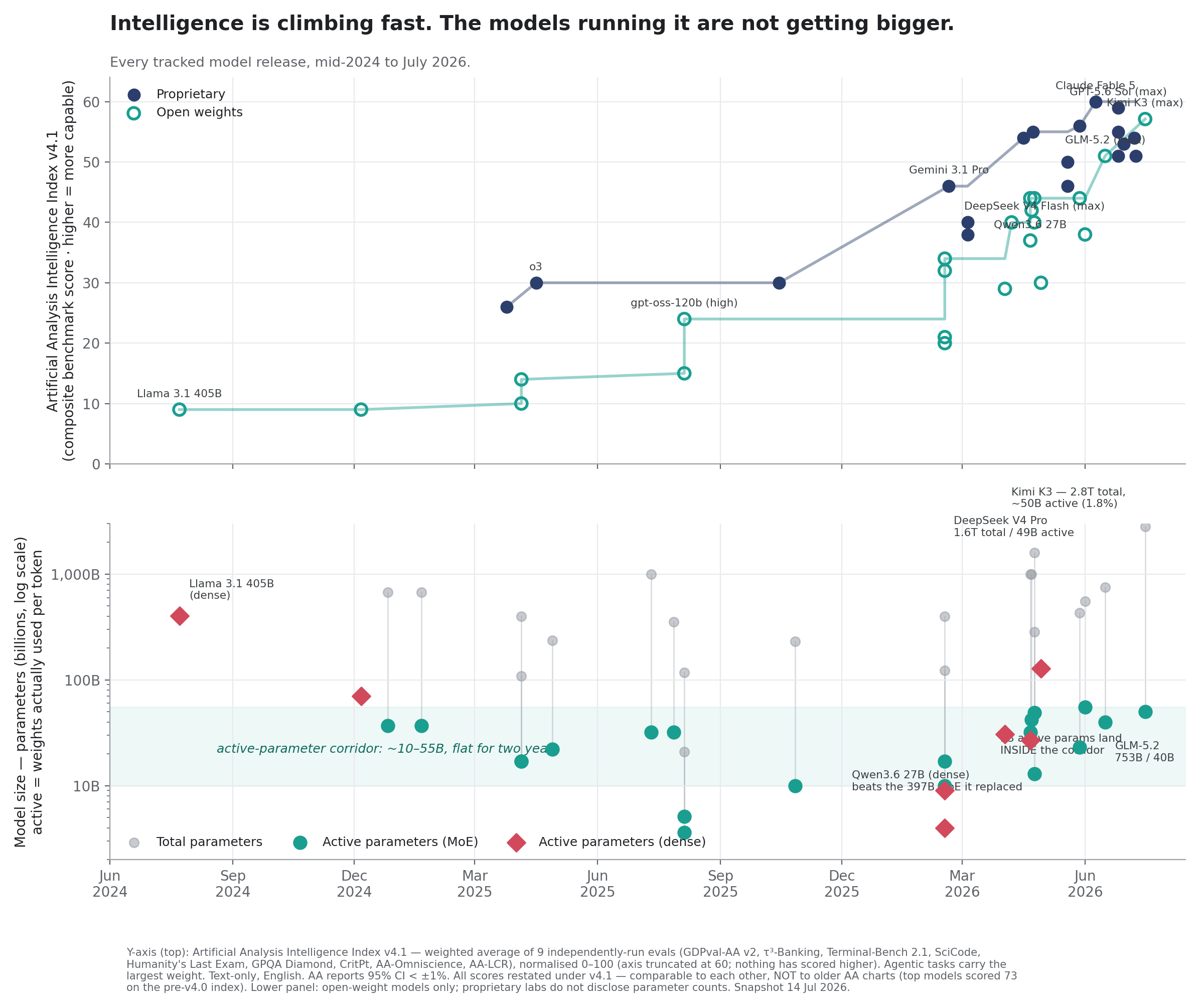
This one is already visible in the pricing. A 4B model scoring 20 on the index costs $0.04 per million tokens. DeepSeek V4 Flash scores 40 for $0.06. Competent general-purpose language understanding is approaching a rounding error.