
What Is Qilin?
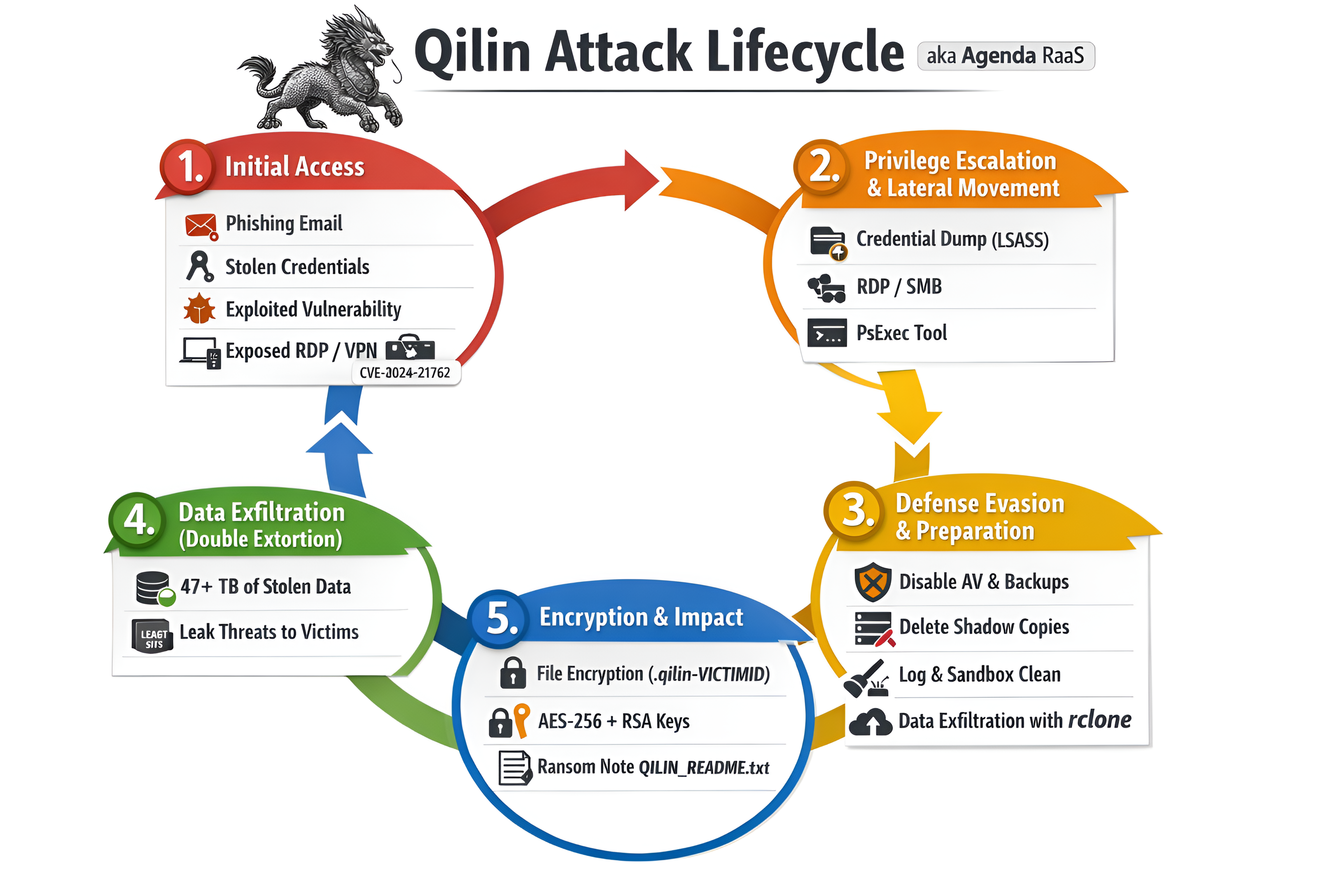
Qilin, also known as Agenda, is a Ransomware-as-a-Service (RaaS) group active since mid-2022. Instead of attacking victims directly, Qilin operates a service model that enables the adversarial group to scale rapidly and adapt quickly to new targets:
Core operators build and maintain the ransomware platform
Affiliates conduct intrusions, steal data, and deploy encryption
Revenue is shared, with affiliates keeping the larger cut
Why Qilin Is Dangerous
Qilin combines technical sophistication with operational scale, making it one of the most impactful ransomware ecosystems observed in recent years. In 2025, Qilin was recognized by the FBI as the #2 most reported ransomware variant, targeting organizations in more than 60+ countries.
Qilin at a glance:
700+ attacks reported in 2025
Multi-platform payloads: Windows, Linux, VMware ESXi
Double extortion: data theft + encryption
Broad targeting: healthcare, manufacturing, government, education, finance
Some Technical Highlights
Ransomware-as-a-Service (RaaS) Architecture
Core operators maintain tooling and infrastructure; affiliates handle intrusions and execution
Revenue-sharing model enables rapid scaling and global reach
Multi-Platform Encryptors
Native support for Windows, Linux, and VMware ESXi
Payloads written in Rust and Go for portability and performance
Password-Gated Execution Control
Encryptor requires a command-line password
Password is SHA-256 hashed and validated against embedded configuration
End-to-End Double Extortion Workflow
Data exfiltration precedes encryption
Stolen data leveraged via affiliate-managed leak sites to amplify pressure
Credential Theft and Lateral Movement
LSASS credential dumping (e.g., Mimikatz)
Propagation via RDP, SMB, and PsExec
Aggressive Defense Evasion
Terminates AV, EDR, backup, database, and virtualization processes
Deletes shadow copies and disables recovery mechanisms
Flexible Encryption Strategies
Supports full, fast, step-skip, and percentage-based encryption modes
Optimized for speed in large enterprise environments
Strong Cryptographic Implementation
Per-file AES-256-CTR encryption
Keys wrapped using RSA for centralized ransom control
Pre-Execution Anti-Analysis
Anti-debugging and anti-VM checks (PEB inspection, timing, CPUID)
Dynamic API resolution to hinder static detection
Operational Precision
Targeted file-type selection with size-based exclusions
Drops QILIN_README.txt ransom note per directory for consistent victim messaging