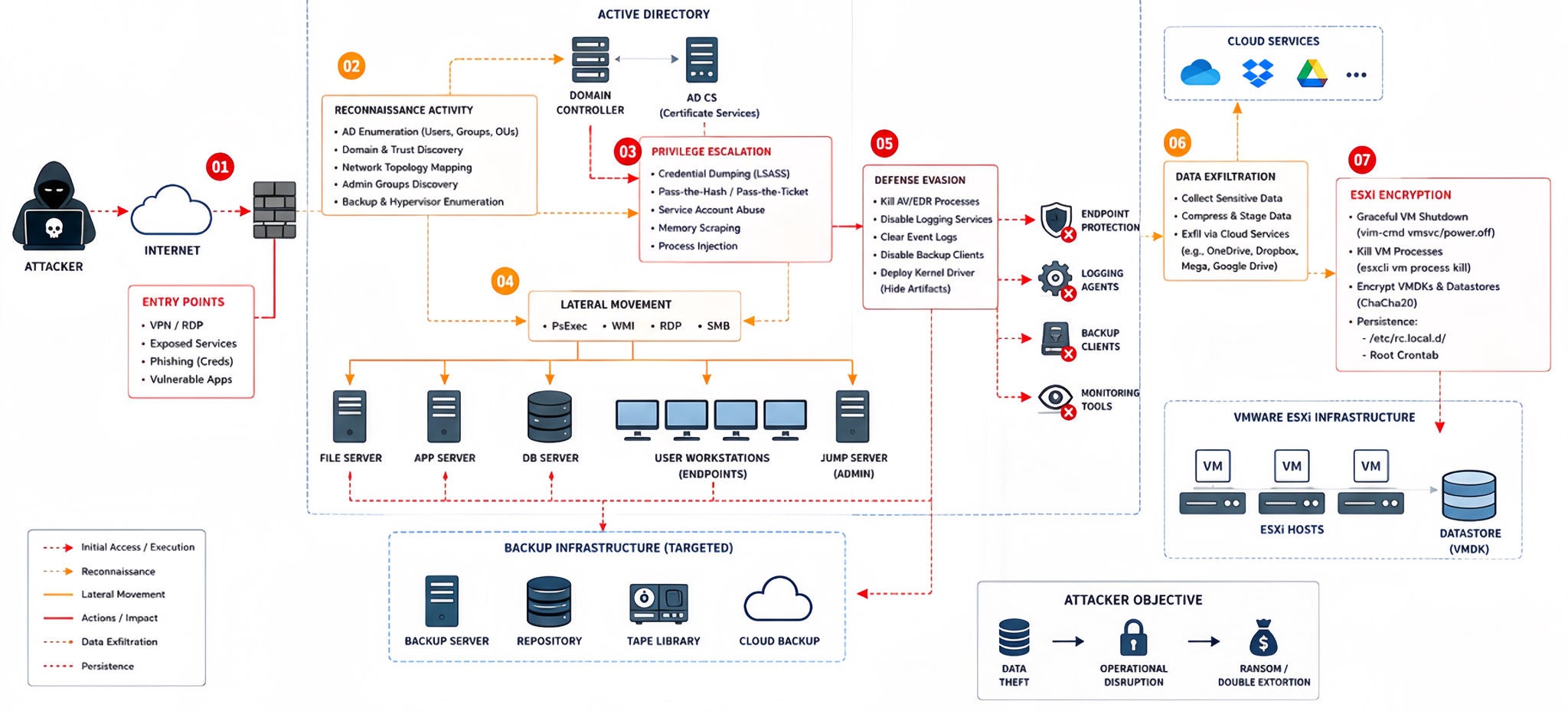
Phase
| What Attackers Do
|
01
Critical
| Initial Access
Compromised credentials, exposed remote interfaces, or vulnerable access infrastructure. Lightweight native commands begin mapping identities, domains, and network topology.
|
02
Elevated
| Reconnaissance
A silent survey of Active Directory, admin groups, and infrastructure nodes stretched over hours or days to avoid detection. Backup systems and hypervisors are specifically targeted for enumeration.
|
03
Critical
| Privilege Escalation
Credential dumping, service account abuse, memory scraping, and process injection elevate access to domain-level control. This is the transition from presence to dominance.
|
04
Elevated
| Lateral Movement
PsExec, WMI, RDP, and SMB channels carry payloads laterally through the environment while blending seamlessly into normal administrative traffic.
|
05
Critical
| Defense Evasion
Endpoint protection, logging agents, and backup clients are systematically killed. Advanced cases deploy kernel-level drivers to suppress defenses at the source, blinding your recovery options.
|
06
Elevated
| Data Exfiltration
Before encryption fires, sensitive financials, customer records, and internal assets are packaged and exfiltrated via cloud tools. This enables double-extortion pressure regardless of a successful data recovery.
|
07
Critical
| ESXi Encryption
VMs are gracefully shut down via vim-cmd vmsvc/power.off, with resistors force-killed via esxcli vm process kill. ChaCha20 encrypts virtual disks and datastores in minutes. Persistence via /etc/rc.local.d and root crontab ensures the attack survives reboots.
|
⚠ Technical Note — ChaCha20 Encryption
The Gentlemen use ChaCha20: the same high-speed cipher that powers HTTPS, VPNs, and secure messaging apps. Purpose-built for speed, it can encrypt multi-terabyte virtual datastores within minutes. Persistence mechanisms ensure the ransomware survives unexpected reboots and resumes automatically, preventing any window for recovery intervention.
The Cleanup That Makes Forensics Harder
Sophisticated ransomware operations don’t stop at encryption. Once the damage is done, the Gentlemen systematically remove their binaries, clear command histories, and scrub forensic artifacts. The goal: delay incident response, complicate attribution, and prevent defenders from understanding precisely how the breach succeeded, making future prevention significantly harder and more expensive.
What Makes This Different From Endpoint Ransomware
The architecture of this attack tells a specific story. The Gentlemen don’t assume backups aren’t in place; they plan for, target, and work around them. By actively locating and attempting to disable backup agents (Phase 5). Through double extortion, they ensure that even a successful recovery keeps ransom pressure alive.
Since this unique threat model differs from the endpoint-centric attacks organizations designed their defenses around, it demands a fundamentally different response.
“Modern ransomware actors focus heavily on locating and disabling backups to strip victims of their recovery options. Organizations must build their resilience postures with this specific threat in mind.”
Changing The Calcus: Three Principles of Cyber Resilience
The answer to such ransomware isn’t better endpoint protection or faster incident response. Its structural separation ensures that backup and recovery environments cannot be reached, altered, compromised, or encrypted by attackers that achieve domain-level access in your production infrastructure.
Isolated by Design
Backup infrastructure in a fully managed SaaS environment, isolated from on-premises or cloud footprint, is invisible to attackers and outside the blast radius of production environments. No agent to kill. No server to encrypt. No credentials to steal.
| Immutable and Tamper-Proof
Backup data that cannot be modified, deleted, or encrypted even by compromised admin credentials, rogue actors, or autonomous AI Agents removes the leverage ransomware operators depend on.
| Resilient Under Attack
Maintaining the ability to execute a clean, trustworthy recovery while an attacker may still be present in your environment is the true test of cyber resilience, minimizing attacker advantages and turning a potential catastrophe into a manageable incident.
|
The Resilience Standard
Cyber resilience isn't about preventing every attack. It’s about ensuring that no breaches, regardless of sophistication or access level, can permanently compromise your ability to recover. Organizations that structurally separate their recovery posture from their production environment remove the most dangerous assumption attackers make: that your backups are within reach.
What Defenders Should Do Right Now
Organizations running virtualized environments should treat hypervisor security as a tier-one priority on par with identity and endpoint protection. Practically, that means taking several immediate steps:
- Audit your ESXi access controls. Administrative access to your hypervisor layer should be tightly scoped, multi-factor protected, and ideally managed through privileged access workstations that are fully isolated from your general corporate network.
- Examine your backup architecture honestly. If your actual backup runs inside the same Active Directory domain that attackers can compromise, your backups are within the attack blast radius. The Gentlemen’s attack chain (Phase 5) exists specifically to find and neutralize them, requiring that backup utilities live outside production environments to protect against domain-level compromise.
- Invest in proactive detection. Missed signals during the reconnaissance and lateral movement phases limit awareness to when the attack has already succeeded (Phase 7). Detection opportunities against unusual AD enumeration patterns (Phase 2), credential access (Phase 3), and anomalous admin tool usage across multiple hosts (Phase 4) offer early warning indications of risk. By focusing detection resources on the endpoint or perimeter, you create a blind spot to stealthy adversarial movements within your environment.
- Test your recovery operationally, not theoretically. Can your team restore a complete ESXi environment from a known-good backup under adversarial conditions, in a timeframe that keeps the business viable? If you do not routinely and actively test your recoverability posture, you may not be prepared to respond when your business needs it most.
The Bottom Line for Security Leaders
The Gentlemen ESXi ransomware campaign is a clear signal of where the threat landscape is heading. Ransomware operators are weaponizing identity, climbing the infrastructure stack, and targeting the layers that control the most assets with the fewest individual targets. A single successful hypervisor compromise can produce more operational disruption than hundreds of endpoint infections, further driving attacker behavior in this direction.
The organizations that will weather this threat most successfully are not those with the most endpoint agents deployed. They are the ones that have built cyber resilience into their data architecture, structurally separating their recovery capability so that even a worst-case compromise leaves the recovery path intact, trustworthy, and fast.
Resilience is not a feature. It’s an architectural commitment. Now is the time to make it.
See How Druva Protects ESXi Environments