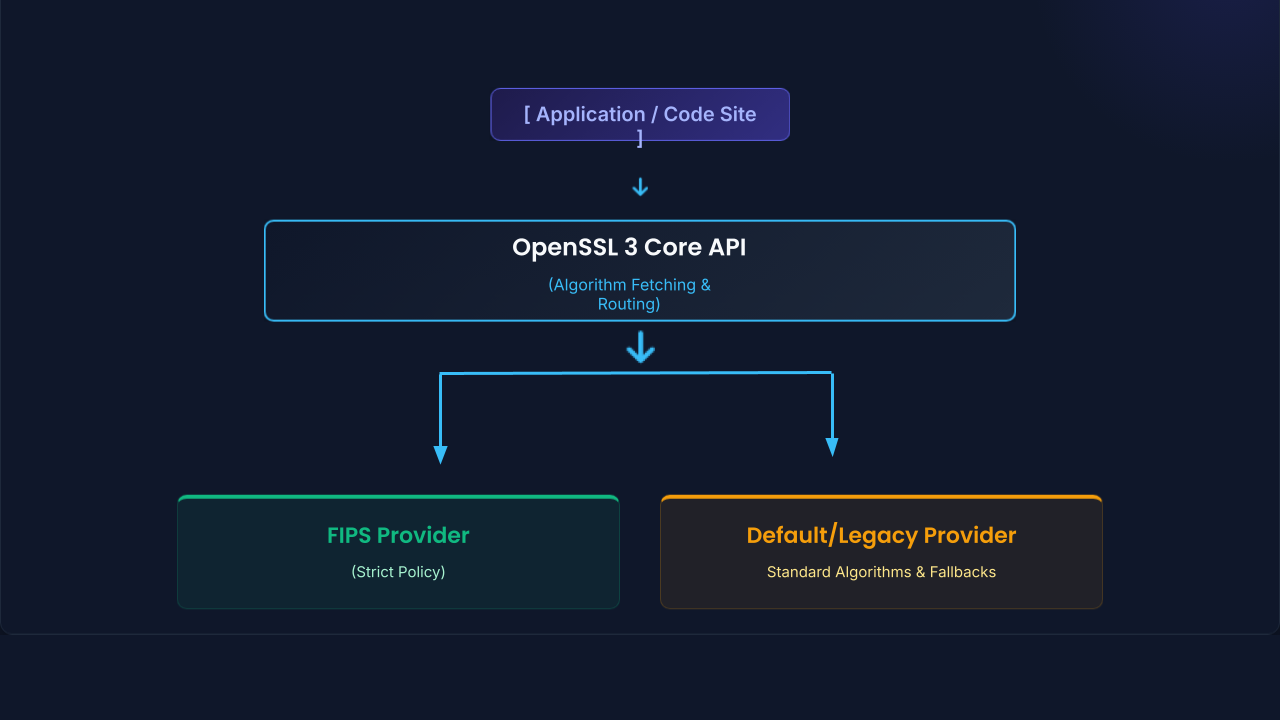
This forced the application runtime to throw an explicit exception during testing, exposing the non-compliant dependency path before it ever reached production.
The Go Paradigm: Embracing BoringCrypto
Go handles cryptography fundamentally differently by embedding its own native, highly optimized assembly primitives directly into the standard library (crypto/...). However, native Go cryptographic primitives are not validated modules.
For Go applications, the industry-standard path to FIPS 140-3 compliance involves utilizing BoringCrypto (via GOEXPERIMENT=boringcrypto) to hook the Go standard library directly into a validated cryptographic module boundary. This cleanly shifts the engineering complexity away from application source code modifications and into build-time pipeline configurations.
Example Scenario 2: Toolchain Drift in a Distributed Team
- The Scenario: A high-throughput telemetry service written in Go is deployed across a cluster. The central CI/CD pipeline is strictly configured to build production binaries using an official, hardened Golang builder image that enforces FIPS compilation flags. During a critical production incident, a developer builds an emergency hotfix binary directly on their local machine and manually deploys it to a container. The hotfix resolves the outage, but hours later, a continuous container attestation scanner flags the pod for immediate quarantine.
- The Root Cause: While the developer’s application source code was identical and completely safe, their local machine's Go toolchain lacked the explicit environment variables (GOEXPERIMENT=boringcrypto) and system tags required to link into the underlying validated cryptographic module boundary. The emergency binary had silently compiled using native, unvalidated Go crypto primitives.
- The Mitigation: The engineering organization instituted two layers of defense. First, they implemented automated container image linting at the registry level that executes a binary analysis gate:
# Programmatically checking for the presence of the boringcrypto hooks
go tool nm ./telemetry-service | grep "_Cfunc__goto_boringcrypto"
Second, they configured their admission controllers to reject any container image lacking a valid cryptographic build attestation signature generated by the central CI/CD pipeline, completely mitigating local build drift.
4. The "How" (Part 2): Pre-Migration Blast Radius Assessment
Before writing or refactoring a single line of code, your architecture team must map out the full blast radius of the system. Skipping a comprehensive upfront inventory guarantees costly architectural rollbacks mid-flight.
Use this standardized matrix to inventory and classify your service catalog:
Cryptographic Inventory Dimensions
Dimension
| What to Capture
| Why It Matters
|
Language & Runtime
| Python 3.x, Go versions, Nginx/Edge proxies, etc
| Dictates the appropriate target FIPS module, linking constraints, and upstream vendor lifecycles.
|
OS & Base Image
| Linux distribution versions, container base configurations
| OpenSSL 3's provider model requires native, operating system-level configuration support.
|
Linking Model
| Static vs. Dynamic library linking
| Defines the boundaries of your validated modules. Static linking means an upstream security patch requires a full recompilation of all dependents.
|
Dependency Chain
| Transitive packages (gevent, cryptography, pyOpenSSL, gRPC)
| Cryptographic wrappers must be explicitly compatible with the core engine; a single unaligned dependency can block a service upgrade.
|
TLS Configuration
| Supported protocols (TLS 1.2 vs. 1.3), explicit cipher suites
| Intersects directly with the module's approved algorithm policies; non-approved ciphers must be stripped out.
|
Recommended Discovery Process
- Automated Scanning: Do not rely on manual questionnaires or spreadsheets. Run automated scanning tools across your repositories and container registries to detect linked cryptographic library versions and active binary architectures.
- Cohort Classification: Group your distributed microservices into logical migration cohorts based on their runtime and operating system profile (e.g., Cohort A: Go 1.25+ on Alpine, Cohort B: Python 3.11 on Ubuntu 22.04).
- Define Runtime Success Criteria Upfront: Establish your exact runtime verification criteria before refactoring begins. Ensure your staging environments execute automated probe requests that programmatically query and assert that the FIPS provider is actively handling traffic.
5. How to resolve Python sequencing and policy delta issues in OpenSSL 3 FIPS?
Policy Deltas and Strict FIPS Mode
Moving to a FIPS 140-3 validated module often introduces strict runtime algorithm rejections that catch teams off guard. A clear example of this is the handling of modern elliptic curves.
In a standard cloud configuration, a microservice might negotiate the highly efficient X25519 curve for Key Exchange (KEX) without issue. However, when switched to a strict FIPS 140-3 validation boundary, that exact handshake may fail instantly. This happens because the specific validated module's Approved Algorithms List (legally defined by its formal CMVP security policy) may only expose specific NIST prime curves, such as P-256, P-384, or P-521. Handshake failures will persist across your network until your TLS configuration profiles are restricted to match exactly what the module is legally allowed to exercise.
The Legacy Python Sequencing Problem
Legacy Python 2.7 services remain a persistent friction point in enterprise environments. Modern cryptographic libraries (such as cryptography and pyOpenSSL) have long dropped support for Python 2.x, yet legacy application layers cannot bind to OpenSSL 3 providers without introducing severe memory stability and functionality risks.
- The Resolution Pattern: Treat language runtime modernization as a strict, non-negotiable prerequisite. Engineering roadmaps must explicitly sequence an upgrade to a modern interpreter (e.g., Python 3.11+) and uplift the underlying base OS (e.g., from an end-of-life distribution to a modern long-term support release) before attempting to inject OpenSSL 3 FIPS provider configurations.
6. The Parallel Journey: TLS 1.3 Readiness
FIPS 140-3 adoption timelines often intersect with TLS 1.3 enablement initiatives, frequently accelerated by regulatory standards such as NIST SP 800-52 Rev. 2. While TLS 1.3 optimizes network latency via a streamlined 1-RTT handshake and favors forward secrecy by default, deploying it alongside strict cryptography requires distinct validation tracks.
- Toolchain Defaults: TLS 1.3 may be compiled as disabled by default within specific vendor-provided BoringCrypto variations. Runtimes must explicitly toggle configuration parameters to enable the protocol.
- Strict Signature Deprecation: Newer toolchains executing under strict standards enforce the deprecation of legacy algorithms (such as SHA-1 signatures used in older TLS 1.2 handshakes). If your system interacts with legacy client endpoints or external third-party webhooks, these connections will drop unexpectedly.
Example Scenario 3: The Broken Legacy Client Handshake
- The Scenario: An engineering team successfully upgrades their core Nginx-based edge proxies to OpenSSL 3 in strict FIPS 140-3 compliance mode, simultaneously rolling out TLS 1.3 across all public endpoints. Within minutes of deployment, an automated, business-critical data ingestion pipeline managed by an enterprise customer drops its connection and begins throwing unhandled TLS handshake errors.
- The Root Cause: The enterprise customer's client integration environment was running an outdated, legacy TLS implementation that relied on SHA-1 hashing algorithms to verify digital signatures during the cryptographic handshake. Under strict FIPS 140-3 validation rules and modern TLS 1.3 constraints, SHA-1 is completely unapproved for digital signatures due to collision vulnerabilities. The newly hardened edge proxies correctly and automatically rejected the client's connection request.
- The Mitigation: This scenario reinforces why upfront client inventory is vital. To resolve the block without rolling back the platform's overall security posture, the platform team isolated the legacy traffic using an independent, strictly bounded gateway routing path. This gateway allowed a tightly monitored TLS 1.2 fallback configured exclusively with approved AES-GCM cipher suites and SHA-256 signature blocks, giving the enterprise customer a clear timeline to modernize their client infrastructure.
7. Migration Implementation Matrix
When designing your engineering runbooks, use this technical architectural breakdown to guide your various service cohorts:
Migration Dimension
| Python Service Cohort
| Go Service Cohort
| Edge Proxies (e.g., Nginx / HAProxy)
|
Core Crypto Library
| OpenSSL 3.x
| BoringSSL / BoringCrypto
| OpenSSL 3.x
|
FIPS Module Target
| Validated OpenSSL FIPS Provider
| BoringCrypto FIPS Module
| Platform-aligned OpenSSL Module
|
Linking Model
| Dynamic Linking (libssl/libcrypto via base OS layer)
| Static Linking (compiled natively into the application binary)
| Dynamic or Static depending on proxy compilation flags
|
Integration Path
| cryptography / pyOpenSSL → OpenSSL 3 Provider API
| Standard library crypto/tls via GOEXPERIMENT=boringcrypto
| ssl_ configuration directives mapped directly to provider blocks
|
Self-Test Behavior
| Power-on KATs executed via provider at initial process startup
| Cryptographic self-tests executed at binary initialization; hard crash on failure
| KATs triggered automatically at proxy worker initialization
|
Primary Operational Risk
| Silent fallback to non-FIPS default provider if configuration drops
| Toolchain version drift across distributed engineering groups
| Edge container images lagging behind core platform security baselines
|
Conclusion: Engineering for Compliance Truth
The most challenging aspect of a modern FIPS 140-3 migration is rarely the mathematics behind the cryptographic primitives themselves; it is the operational complexity of managing cryptographic state across a distributed system.
Is a migration of this scale perfect from day one? No. It is an iterative engineering journey. Treating compliance not as a paper checkbox, but as a core distributed systems problem - by standardizing on golden base images, building automated pipeline testing gates, and designing for deterministic fail-closed behaviors - ensures your platform can confidently navigate strict security audits while maintaining production performance, stability, and engineering velocity. Visit Druva Security Trust Center
Ready to Simplify Your Cloud Compliance & Data Resilience?
Upgrading your cryptographic pipelines for FIPS 140-3 compliance is only half the battle—ensuring your backup, recovery, and data protection perimeters are equally resilient is essential.
Discover how the Druva Resilience Cloud delivers seamless, FIPS-compliant end-to-end data protection for enterprise and public sector workloads.
Schedule a Demo with a Druva Specialist