Key Benefits
- Precision Detection: Go beyond anomaly detection to confirm true ransomware impact with high-confidence signals and near-zero false positives.
- Smart Alert Prioritization: Focus on what matters using clear severity levels — from early warnings to confirmed critical alerts — based on the strength of evidence.
- Zero-Day Threat Protection: Detect known, unknown, and emerging ransomware strains by recognizing behavioral patterns and encryption techniques.
- Evidence-Driven Clarity: Access forensic evidence behind every critical detection for a deeper understanding of what changed, why it matters, and whether ransomware impact is confirmed.
- Scalable Intelligence: Continuously evolve detection efficacy through field-driven telemetry, threat intelligence, and ongoing model refinement.
- Confident Recovery: Clearly differentiate affected vs. clean recovery points to safely restore the business without second-guessing.
Our Approach: Detect, Validate, Recover
Druva Ransomware Detection feature is built around a progressive stage model.
- The first stage looks for behavioral indicators associated with ransomware.
- The second stage performs deeper forensic analysis to determine whether ransomware has actually impacted the data.
Then brings those findings directly into cyber recovery so administrators can identify, validate, and recover from a trusted point. Behavior narrows the field. Forensics confirms the impact. Recovery turns the conclusion into action.
Stage 1: Behavioral Detection
Detect potential ransomware activity based on behavioral signals.
In this stage, Druva continuously evaluates backup snapshots for high-risk behavioral indicators like mass renaming, ransom notes, and suspicious and novel file extensions against proprietary AI/ML models, rather than just relying solely on known file hashes or extensions. When high-risk indicators are identified, Druva raises a “Suspicious Indicators Found” alert, signaling potential ransomware activity and automatically escalating the snapshot for forensic validation.
Stage 2: Forensic Validation
Confirm ransomware presence and encryption impact.
At this stage, backup snapshots undergo advanced structural verification, entropy analysis, and statistical checks to validate the presence of encryption. If encrypted files are detected, the administrator receives a critical severity alert “Encryption Detected” — indicating that ransomware impact is confirmed. The alert is backed by multiple forensic indicators, enabling administrators to clearly understand:
- Was the backup data impacted?
- What evidence confirms the impact?
- Which recovery point preceded the infection?
- Can that recovery point be validated before restoration?
Stage 3: Cyber Recovery
Turn detection evidence into a recovery decision.
Detection is only as valuable as what you do next. Druva surfaces ransomware findings in Recovery Insights and the Security Command Center, giving users correlated signals and explainable evidence that’s connected directly within native recovery workflows. From there, administrators can:
- Understand: Review the correlated indicators and supporting evidence to understand the alert, the behavioral signals, and the scope of impact.
- Assess and Select: Use those insights to identify the last-known-clean recovery point and distinguish potentially impacted snapshots from clean candidates.
- Validate and Recover: Run a Restore Scan against the selected recovery point and proceed with recovery using validated data.
This is where detection delivers true value for your overall incident response and cyber recovery strategy. It transforms a simple security alert into a clear, validated roadmap back to clean data.
How This Fits With Druva’s Broader Detection Capabilities
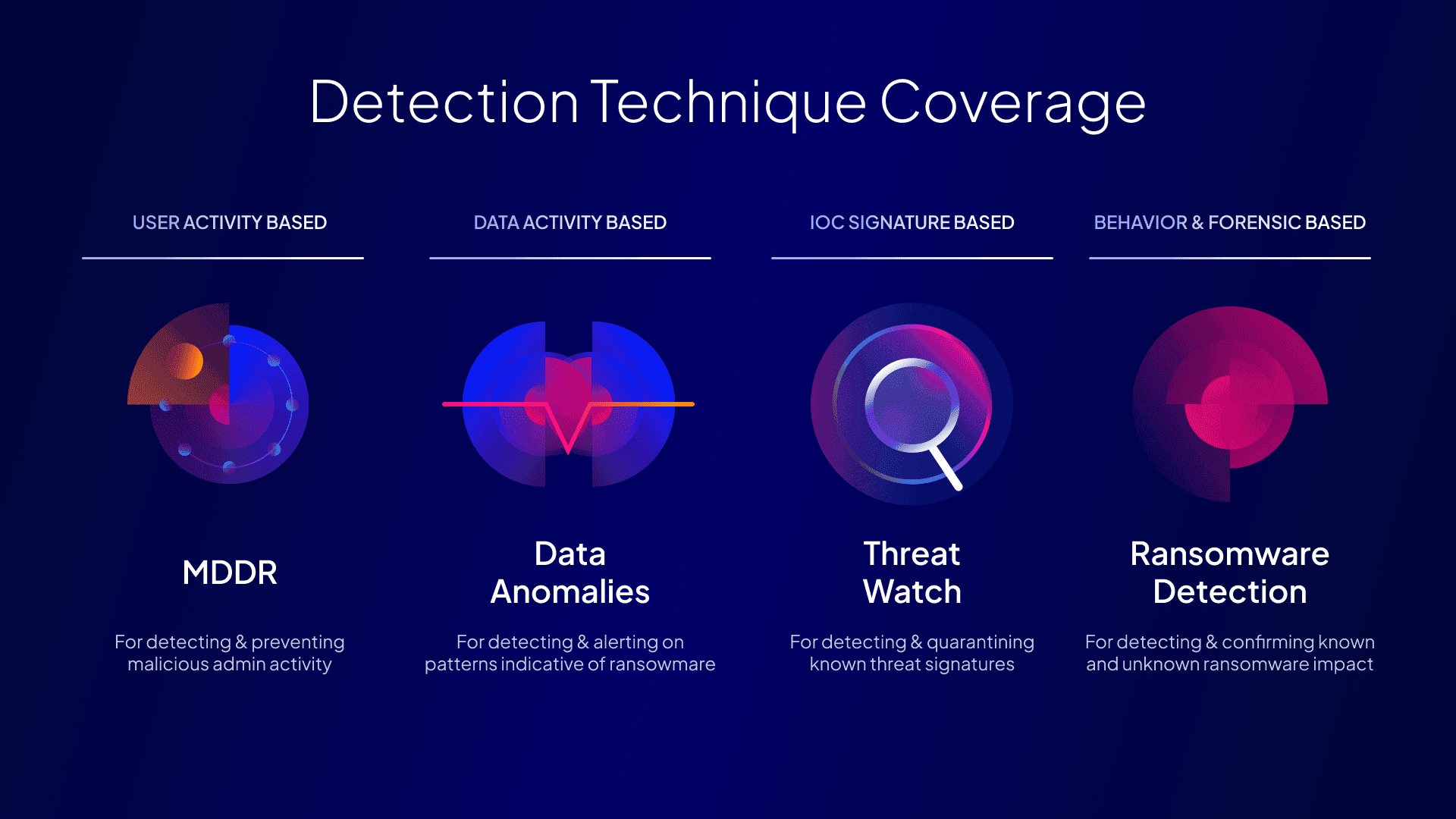
Ransomware Detection is the latest investment in Druva’s detection capabilities, complementing existing features while advancing how customers can identify and cleanly recover from ransomware attacks.
- Ransomware Detection: Multi-stage, AI-powered detection for known and unknown ransomware and post-compromise encryption. Behavior-driven with built-in validation.
- Data Anomaly Detection: AI/ML powered detection to flag unusual data activities. Flags on anomalous and unusual file patterns (create/modify/delete, entropy) but can’t confirm if it’s truly malicious.
- Threat Watch: Continuous IOC-based scanning to detect specific known threats using Druva’s IOC — threat intelligence library.
- MDDR: 24x7x365 monitoring of the backup environment for early detection of threats and destructive user actions. Primarily detection at the admin level (ie, deletions, policy changes, or unauthorized access), not at the data level.
Getting Started
Druva Ransomware Detection is a plug-and-play capability available within our Premium Security SKU. It is under Limited Availability (LA) starting September 17, 2026, with current support for the following workloads:
For more information on Druva Ransomware Detection, or to participate in our Limited Availability release, please contact your Account Manager or raise a case via Dru Assist to enable this feature.
FAQs